
Your Hair Transplant Day: What to Expect, Step by Step
Quick Answer: How Long Does a Hair Transplant Take?
At Van Scoy Hair Clinics, a Multi-Unit Hair Grafting (MUHG™) procedure typically takes 3.5–5 hours, and FUE typically takes 4–8 hours, depending on the number of grafts.
Most patients are awake and comfortable the entire time under local anesthesia and go home the same day. Below is exactly what happens, step by step.
Before Your Procedure: What to Do the Night Before and Morning Of
- EAT A FULL MEAL beforehand. You will be at the clinic for several hours, and eating helps prevent lightheadedness during the procedure.
- AVOID ALCOHOL for 48 hours and blood-thinning medications or supplements for the period your physician specifies at your consultation (aspirin, ibuprofen, fish oil, vitamin E).
- WEAR A BUTTON-UP OR ZIP-UP SHIRT, anything that does not need to pass over your freshly treated scalp.
- ARRANGE A RIDE HOME. You won’t be under general anesthesia, but you will be groggy from the local anesthesia and any relaxation medication, and Van Scoy requires patients to have a ride after the procedure.


Preparing for Your Consultation
You can request a consultation online or by phone, and the process typically takes just a few minutes.
It is helpful to have a general sense of your hair loss history on hand:
- When you first noticed thinning,
- Whether it runs in your family, and
- Any treatments you’ve already tried
But nothing formal is required. If you’re able to bring a list of current medications or supplements, that speeds up the medical history portion of your visit.

What to Expect During Your Hair Transplant Procedure, Step by Step.
Step 1: Morning meeting With Your Surgeon
Before any work begins, your surgeon reviews your hair and family history, your goals from your consultation, and confirms the transplant plan, including graft count, donor area health, and hairline design, one more time with you. This is your last chance to ask questions before the day’s plan is finalized.
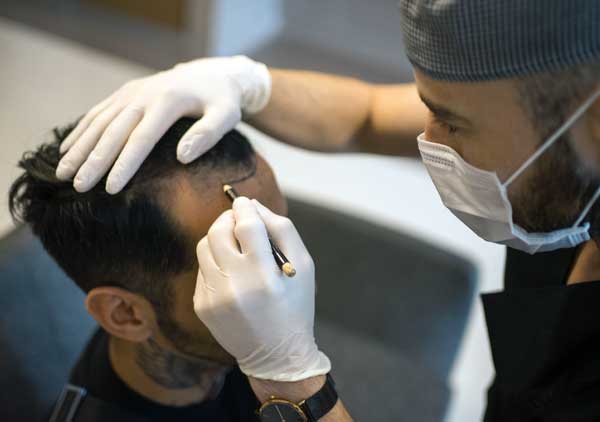
Step 2: Finalizing the Design
Your surgeon measures the treatment area and marks the new hairline and density pattern directly on your scalp. Because MUHG™ and FUE both depend on precise placement for a natural result, this design step is done by hand, in person, matched to your face shape, age, and hair characteristics.
Step 3: Preparing the Donor Area
- MUHG™: A thin strip of hair, roughly the width of a pencil, is trimmed along the back of the head where the donor tissue will be taken.
- FUE: The donor area is trimmed short so individual follicular units can be extracted one at a time with a small punch tool.
Step 4: Local Anesthesia
A local anesthetic numbs the donor and recipient areas so you won’t feel pain during harvesting or placement. You’ll be awake and can talk, listen to music, or rest throughout. There is no general anesthesia involved.
Step 5: Harvesting the Grafts
- MUHG™: A thin section of donor tissue is removed and the area is closed with sutures that are easily concealed by the surrounding hair.
- FUE: Individual follicular units are extracted one at a time through tiny punch sites that heal without a linear scar.
Step 6: Preparing the Grafts
Under magnification, your surgical team separates, counts, and sorts the harvested grafts by the number of hairs in each follicular unit. This sorting matters. It is what allows your team to place single-hair grafts at the hairline for a soft, natural edge and denser multi-hair grafts behind it.
Step 7: Creating the Recipient Sites
Your surgeon creates the tiny recipient sites in the thinning or balding area, controlling the angle, direction, and spacing of each one. This is the step that determines how naturally your new hair will grow in. It is done to match your existing hair’s direction, not a generic pattern.
Step 8: Placing the Grafts
The surgical team places each graft into its recipient site by hand, working systematically across the treatment area until the design is complete.
Step 9: Finishing Up and Going Home
Your surgeon reviews the final placement, and you’ll receive written post-procedure instructions along with guidance on when to wash your hair, when you can return to normal activity, and how to protect the treated area while it heals. Most Van Scoy patients return to non-strenuous work within 2-6 days.
What Happens Next
New grafts typically shed within the first few weeks. This is expected and not a sign the transplant failed. New growth generally begins between three and five months, with results continuing to fill in over the following year. (Link this sentence to the “Your First Year” page once published.)