
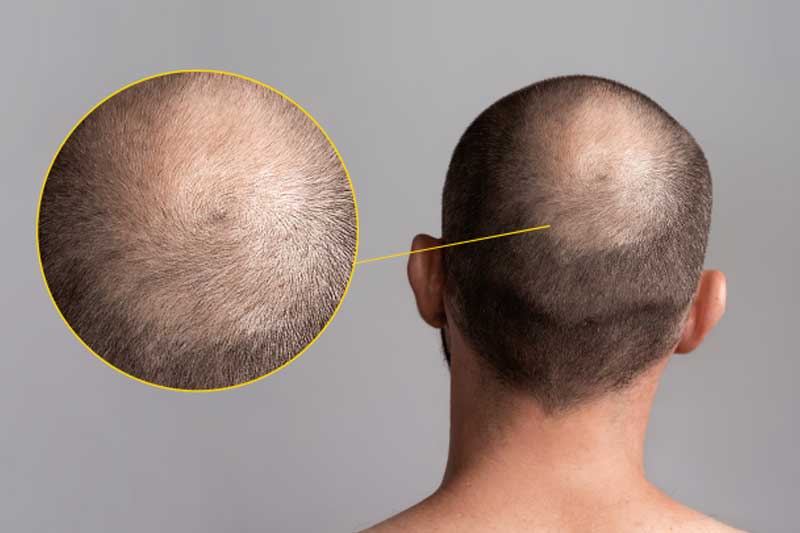
Understanding the Different Types of Hair Loss
Most people notice thinning hair and assume it is simply genetics. But hair loss isn’t one condition, it’s a category. Androgenetic alopecia, alopecia areata, telogen effluvium, and trichotillomania are all different conditions with different causes, different patterns, and different paths forward. Some resolve on their own. Others are progressive and benefit from early intervention. Knowing which type you’re dealing with is the first real step toward doing something about it.
This guide walks through the most common types of hair loss, how they’re typically identified, and what tends to happen next for each one. It is not a substitute for an in-person evaluation, but it should help you walk into a consultation already understanding the terminology and asking better questions.
What Determines Which Type of Hair Loss You Have?
Dermatologists and hair restoration specialists typically distinguish between types of hair loss using a few consistent markers:
- Pattern: Is the thinning diffuse across the whole scalp, or concentrated in specific areas (crown, hairline, temples, or isolated patches)?
- Speed of onset: Did it happen gradually over months or years, or suddenly over a few weeks?
- Family history: Is there a pattern of hair loss in close relatives?
- Recent triggers: Illness, surgery, childbirth, extreme stress, medication changes, or crash dieting in the past several months?
- Scalp condition: Is the scalp smooth and normal-looking in the affected area, or is there redness, scaling, or scarring?
None of these on their own confirms a diagnosis. That requires a proper scalp exam but they’re a useful starting point for understanding which category you likely fall into.
Androgenetic Alopecia (Male and Female Pattern Hair Loss)
What Is Androgenetic Alopecia?
Androgenetic alopecia is the most common type of hair loss, and the one most people mean when they say “genetic hair loss” or “pattern baldness.” It’s a hereditary, progressive condition driven by the hair follicles’ sensitivity to androgens (a group of hormones), which gradually shortens the hair growth cycle and shrinks follicles over time. It typically develops after puberty and progresses gradually rather than suddenly.
Androgenetic alopecia affects a large share of both men and women over their lifetime, and the earlier it’s identified, the more options are typically available. Men are often first candidates for non-surgical hair replacement or, for more advanced thinning, FUE hair transplants; women with pattern hair loss more often start with non-surgical hair replacement designed specifically for women. Because this type of hair loss is progressive rather than self-resolving, many people also begin with a lower-commitment option like PRP hair therapy to slow progression while they weigh next steps.
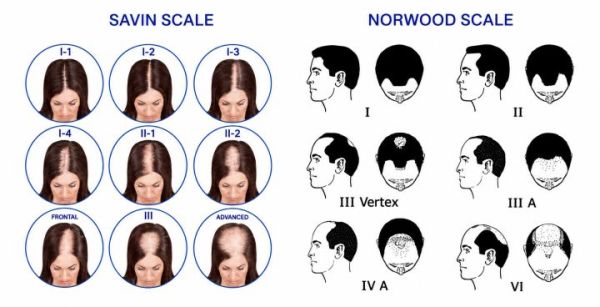
How It Progresses: The Norwood and Savin Scales
Because androgenetic alopecia is progressive, specialists use standardized scales to describe and track it:
- The Norwood Scale classifies male pattern hair loss into stages, from minimal recession at the temples through advanced crown and vertex loss.
- The Savin Scale does the equivalent for female pattern hair loss, focusing on the density and width of the part line as thinning progresses.
These scales matter because they give you and your specialist a shared, objective way to talk about where you are now and what to expect if the condition isn’t addressed.
Who It Affects
Androgenetic alopecia affects a large share of both men and women over their lifetime, and the earlier it’s identified, the more options are typically available. Because it is progressive rather than self-resolving, it is the type of hair loss most associated with active treatment planning rather than a “wait and see” approach.
[Internal link: Men’s Non-Surgical Hair Replacement, HairSkeen® European Men’s Hair Replacement, Women’s Non-Surgical Hair Replacement, FUE Hair Transplants, Multi-Unit Hair Grafting (MUHG™), PRP Hair Therapy for Hair Loss]
Alopecia Areata
What Is Alopecia Areata?
Alopecia areata is an autoimmune condition. The immune system mistakenly attacks hair follicles, causing hair to fall out. Unlike androgenetic alopecia, it isn’t driven by genetics-plus-hormones in the same way, and it isn’t limited to a predictable pattern. It most often starts as one or more round or oval bald patches on the scalp, though it can appear anywhere hair grows, including eyebrows and eyelashes.
Types of Alopecia Areata
Alopecia areata has several recognized presentations:
- Patchy alopecia areata: The most common form, with one or more distinct bald patches
- Alopecia ophiasis: Hair loss in a band along the sides and back of the scalp
- Alopecia totalis: Cmplete loss of scalp hair
- Alopecia universalis: Complete loss of hair on the scalp and the rest of the body
Alopecia areata can be unpredictable. Hair sometimes regrows on its own, sometimes with treatment, and sometimes the condition persists or recurs. Because it’s an autoimmune condition rather than a structural or hormonal one, evaluation by a dermatologist is the appropriate first step, and next steps often look different from those for pattern hair loss. According to the American Academy of Dermatology, a board-certified dermatologist is best positioned to confirm a diagnosis and discuss what treatment, if any, is appropriate.
[Internal link once published: Medical Wigs & Hair Prosthesis — this is the most relevant commercial page for alopecia areata patients, particularly totalis/universalis cases. Until that page exists, route to Hair Loss FAQ and Book Appointment/Request Consultation.]
Telogen Effluvium
What Triggers Telogen Effluvium?
Telogen effluvium is a temporary, diffuse hair shedding condition. Rather than attacking follicles or being driven by genetics, it happens when a physical or emotional stressor pushes an unusually large percentage of hairs out of their normal growth phase and into the resting (telogen) phase all at once. Common triggers include major illness, surgery, childbirth, high fever, significant weight loss, thyroid changes, and prolonged emotional stress.
Shedding usually becomes noticeable two to three months after the triggering event — which is often what makes telogen effluvium confusing to self-diagnose, since the cause and the hair loss don’t line up in time the way people expect.
Is Telogen Effluvium Permanent?
No. According to NIH’s National Library of Medicine, telogen effluvium is a benign, non-scarring condition that is generally reversible once the underlying trigger resolves or is treated, though regrowth can take several months to become noticeable. This is the type of hair loss most likely to improve without a structural intervention — but persistent or chronic cases (lasting more than six months) are worth a professional evaluation to rule out other contributing conditions.
[Internal link: Hair Regrowth pillar — PRP Hair Therapy, Exosome Hair Restoration Therapy, Laser Hair Therapy, Topical Hair & Scalp Treatment Products — framed as supporting recovery and hair quality during regrowth, not as a required treatment.]
Trichotillomania (Hair-Pulling Disorder)
Trichotillomania is different from the conditions above in an important way: it’s classified as a body-focused repetitive behavior, not a dermatologic or autoimmune condition. It involves a recurring urge to pull out one’s own hair, often from the scalp, eyebrows, or eyelashes, and it typically presents as patchy hair loss with irregular edges and hairs of uneven length, rather than a smooth bald patch.
Because trichotillomania has a behavioral and psychological component, the most appropriate first step is usually an evaluation that can address both the hair loss and its underlying cause which may include a referral to a mental health professional alongside dermatologic care. This is a case where the right next step is honest guidance rather than a product recommendation.
[Internal link: Hair Loss FAQ, and Book Appointment/Request Consultation framed around getting a proper evaluation. Avoid linking directly into transplant or regrowth product pages from this section.]
Other Types of Hair Loss Worth Knowing
A few additional conditions come up often enough to be worth defining briefly:
- Traction alopecia: Hair loss caused by prolonged tension on the hair, often from tight hairstyles like braids, weaves, or ponytails. Caught early, it’s frequently reversible.
- Central Centrifugal Cicatricial Alopecia (CCCA): A scarring form of hair loss that begins at the crown and spreads outward, most commonly diagnosed in Black women.
- Tinea capitis: A fungal scalp infection that causes hair loss along with scaling, redness, or crusting; it requires antifungal treatment rather than hair restoration.
| Type | Typical Cause | Typical Pattern | Generally Reversible? |
|---|---|---|---|
| Androgenetic Alopecia | Genetics + hormones (androgens) | Gradual; hairline/crown (men), diffuse crown thinning (women) | Progressive — manageable, not self-resolving |
| Alopecia Areata | Autoimmune | Round/oval patches; can progress to totalis/universalis | Variable — sometimes regrows, sometimes persists |
| Telogen Effluvium | Physical/emotional stress trigger | Diffuse shedding across the scalp | Usually yes, once trigger resolves |
| Trichotillomania | Body-focused repetitive behavior | Patchy, irregular edges, uneven hair length | Depends on addressing the underlying behavior |
| Traction Alopecia | Prolonged tension on hair | Hairline/temples, follows hairstyle pattern | Often, if caught early |
| Tinea Capitis | Fungal infection | Scaling, redness, patchy loss | Yes, with antifungal treatment |
How to Find Out Which Type of Hair Loss You Have
Self-diagnosis from a list like this can point you in the right direction, but pattern, speed, and scalp condition can overlap between conditions enough that a hands-on evaluation is the only way to know for certain. That evaluation is also what determines which path, either non-surgical replacement, transplantation, regrowth therapy, or a referral elsewhere, actually fits your situation.
[Internal link once published: Hair Loss Assessment/Quiz — ideal placement is directly in this paragraph, since this is precisely the reader who doesn’t yet know which category they’re in.]
Your Next Step
If you’re still narrowing down what you’re dealing with, our Hair Loss FAQ answers many of the questions people bring to their first consultation. If you’re ready to get a real answer, scheduling a consultation is the fastest way to find out which type of hair loss you have and what your options look like from there.
EDITORIAL NOTES (internal — remove before publishing)
Built pages linked above: Men’s Non-Surgical Hair Replacement, HairSkeen®, Women’s Non-Surgical Hair Replacement, FUE Hair Transplants, MUHG™, PRP Hair Therapy, Exosome Hair Restoration Therapy, Laser Hair Therapy, Topical Hair & Scalp Treatment Products, Hair Loss FAQ, Book Appointment/Request Consultation. Swap the placeholder / hrefs for real URLs at implementation.
Unbuilt pages flagged for future linking (tracked, not linked yet): Medical Wigs & Hair Prosthesis (Alopecia Areata section), Hair Loss Assessment/Quiz (How to Find Out section). Both are marked in bracketed notes above — search this doc for “once published” when those pages go live.
External links used (2): American Academy of Dermatology (alopecia areata), NIH/NCBI National Library of Medicine (telogen effluvium). Both are authoritative, non-competitor sources per your external linking philosophy.